

The closing date on a Georgia real estate contract feels like a finish line. Movers are scheduled, utilities are transferred, and buyers and sellers have often planned their lives around it. When that date slips, the consequences ripple outward. Buyers may face a rate lock expiration or temporary housing costs. Sellers may have a purchase of their own that depends on this sale closing on time.
Delays are common enough that experienced agents and attorneys build cushion into their schedules. Most delays are also preventable or at least manageable when the parties understand what causes them. This article explains how closings work in Georgia and walks through seven of the most frequent reasons they get pushed back. It also offers practical steps to keep a transaction on track.
How Closings Work in Georgia
Georgia handles real estate closings differently from many other states, and that difference shapes where delays come from.
To begin with, Georgia is an attorney closing state. The Supreme Court of Georgia has held that conducting a real estate closing is the practice of law. A Georgia licensed attorney must therefore conduct or supervise the closing. Title companies and escrow agents cannot close a transaction on their own as they do in some western states.
In a typical financed purchase, the closing attorney is selected by the buyer, subject to lender approval. That attorney represents the lender in the transaction. The attorney examines title, prepares the deed and closing documents, and coordinates with the lender. That office also collects and disburses funds and records the documents with the clerk of superior court in the county where the property is located. Buyers and sellers are free to hire their own attorneys to review the contract and represent their interests. Many do, particularly in complex transactions.
Georgia also uses a security deed rather than a mortgage to secure a home loan. A security deed conveys legal title to the lender until the loan is paid. At that point the lender is required to cancel it of record. This detail matters because uncancelled security deeds are one of the most common title problems in the state.
Finally, Georgia has a good funds statute, found at O.C.G.A. § 44-14-13. It governs how closing funds are delivered and when a closing attorney may disburse. Funds must be collected before they go out, and the attorney is responsible for making sure that happens.
With that framework in place, here are the seven reasons closings most often get delayed.
1. Loan Underwriting Is Not Finished
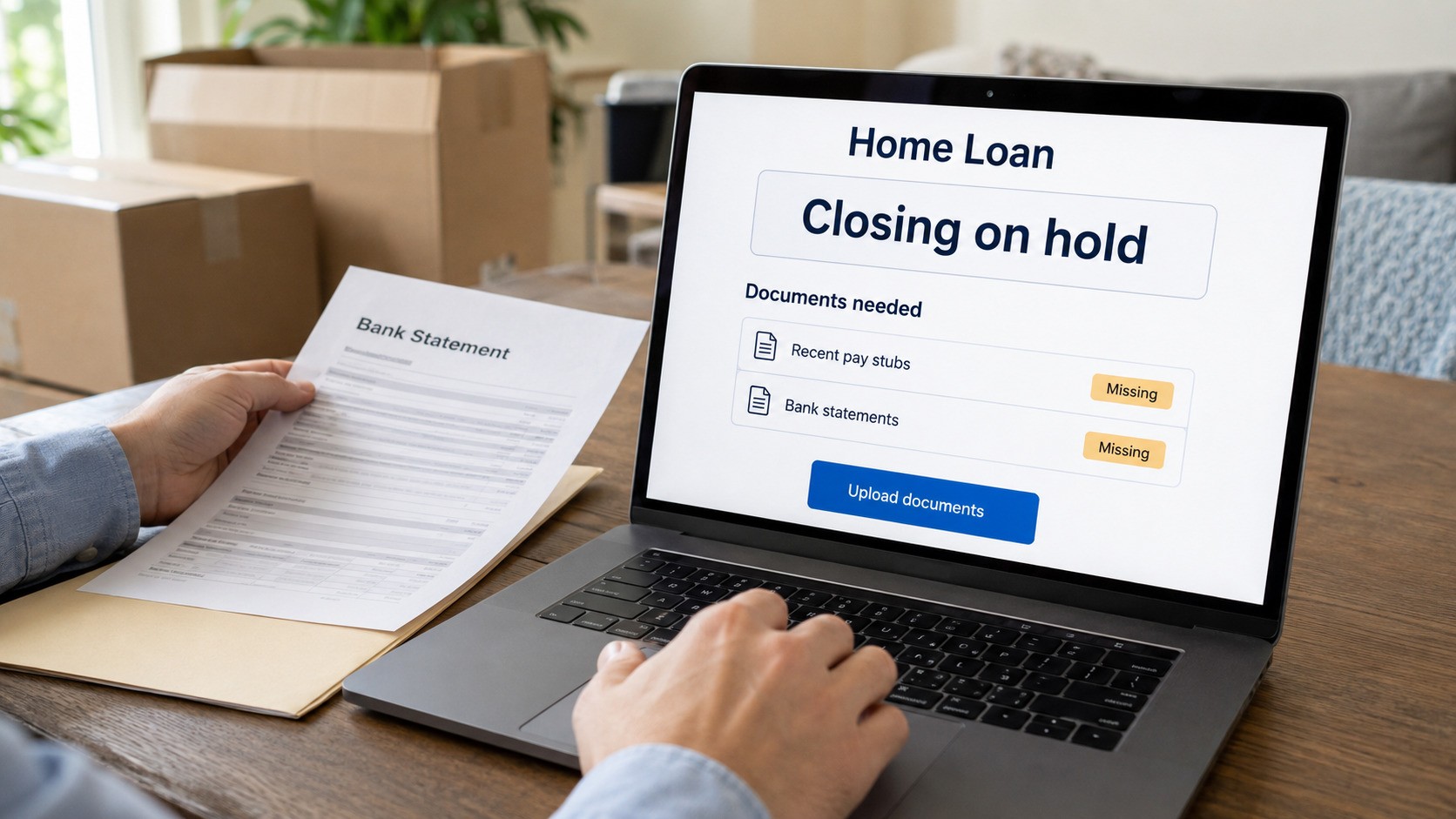
The single most common cause of a delayed closing is a loan that is not ready to fund. A buyer may have a preapproval letter and a signed contract, but preapproval is not final loan approval. Underwriting continues until the lender issues a clear to close, and anything that slows underwriting slows the closing.
Several things create problems at this stage. Lenders request documents in waves. A slow response to a request for a bank statement, tax transcript, or letter of explanation can cost days. Self employed borrowers, borrowers with variable income, and borrowers using gift funds face more scrutiny and more requests. Employment verification is performed shortly before closing, and a job change during the process can require a full re-review.
Changes in the buyer’s financial picture are especially damaging. Opening a new credit account, financing furniture or a vehicle, making a large undocumented deposit, or co-signing for someone else can alter the debt to income ratio. Any of these can trigger a new approval. Lenders typically pull credit again just before closing, and new debt discovered at that point can stop the transaction cold.
Rate locks add pressure. A lock that expires before the closing date may require an extension fee or a new rate. Higher rates can affect qualification.
Buyers can prevent most underwriting delays by responding to lender requests the same day and avoiding any change to employment or credit. Asking the loan officer directly whether the file is on schedule also helps. Sellers and their agents should confirm the buyer’s loan status in the week before closing rather than assuming silence means progress.
2. The Appraisal Comes in Low or Comes in Late
Any financed purchase requires an appraisal, and the appraisal creates two distinct opportunities for delay.
The first is scheduling. Appraisers must be ordered through the lender’s process. In busy markets or rural areas of Georgia, an appointment may take a week or more. Once the inspection is complete, the report must be written, reviewed by the lender, and in some cases sent back for corrections. A late appraisal pushes back underwriting, which pushes back the clear to close.
The second is value. If the appraisal comes in below the contract price, the lender will base the loan on the appraised value. The purchase price no longer controls. Someone has to cover the gap, either the buyer in cash or the seller through a price reduction. Otherwise the parties meet somewhere in between or the contract terminates.
Most residential transactions in the state use the Georgia Association of Realtors purchase and sale agreement. That form contains provisions addressing appraisal contingencies. Depending on how the contract was completed, the buyer may have the right to terminate or the right to request a price reduction. In some cases the buyer has an obligation to close regardless of the appraisal. Negotiating a resolution takes time, and if the parties cannot agree quickly, the closing date passes.
Buyers can reduce appraisal risk by understanding the appraisal contingency in their contract before signing and by having a plan for a low value. Sellers can help by making sure the property is in good condition for the appraisal visit. Providing the agent with information about recent improvements and comparable sales also helps.
3. Title Problems Surface During the Examination
Every closing attorney in Georgia performs a title examination before closing. The examiner reviews the chain of ownership, typically going back fifty years under Georgia title standards. Its goal is to find anything that could cloud the seller’s ability to convey clear title. Problems found during this process are among the hardest delays to resolve. They often involve people who are not parties to the transaction.
Uncancelled security deeds are the most frequent issue. When a Georgia homeowner pays off a loan, O.C.G.A. § 44-14-3 requires the lender to cancel the security deed of record within sixty days. Lenders do not always comply, particularly when a loan was sold or the original lender merged or went out of business. A security deed from a loan paid off fifteen years ago may still appear in the chain. Clearing it requires locating the current holder of the debt and obtaining a cancellation. That can take days or weeks.
Other common title problems include judgment liens against the seller, unpaid property taxes, tax liens, and mechanic’s liens from recent construction. Errors in prior deeds, such as misspelled names or incorrect legal descriptions, are also frequent. Boundary issues can arise when a survey shows a fence, driveway, or structure crossing a property line.
Estate and family situations create their own category of delay. If a prior owner died and the property passed through an estate, the examiner must confirm that the estate was properly administered. All heirs must have signed the necessary documents. Divorces can leave a former spouse on title. Properties owned by trusts, limited liability companies, or partnerships require documentation showing who has authority to sign.
Sellers can prevent many of these delays by ordering a preliminary title search early, ideally before listing the property. Anyone who has paid off a loan should confirm that the security deed was cancelled of record. If a problem exists, discovering it in the first week of the transaction rather than the last gives time to fix it.
4. The Closing Disclosure Timeline Resets
Federal law imposes a waiting period that many buyers and sellers do not know about until it delays their closing.
Under the TILA-RESPA Integrated Disclosure rule, commonly called TRID, a lender must provide the borrower with a Closing Disclosure before closing. The borrower must receive it at least three business days before the loan is consummated. This multi-page document shows the final loan terms, closing costs, and cash to close. That period is counted in business days, which for this purpose excludes Sundays and federal holidays.
Certain changes after the Closing Disclosure is issued require a new disclosure and a new three day waiting period. These include an increase in the annual percentage rate beyond a specified tolerance and a change in the loan product. Adding a prepayment penalty also qualifies. Smaller changes can be reflected on a corrected disclosure at closing without restarting the clock.
The delay happens when the lender issues the Closing Disclosure late or when a last minute change triggers a new waiting period. A closing scheduled for Friday cannot happen if the Closing Disclosure is first delivered on Wednesday. Late figures from the closing attorney or late seller concessions can cause this. So can a late decision by the buyer to change the loan structure.
The best prevention is early coordination between the lender, the closing attorney, and the agents. Final figures should be exchanged well before the deadline, and any changes to the deal should be settled at least a week before closing.
5. Funds Do Not Arrive When They Should
A closing cannot be completed until the money is in the closing attorney’s trust account. Funding problems delay closings in several ways, and some of them involve real risk to the parties.
Georgia’s good funds statute requires that a closing attorney receive collected funds before disbursing. In practice, closing attorneys require wire transfers for buyer funds above a modest threshold, and personal checks are not accepted. A buyer who arrives at closing with a personal check will not close that day. The same is true of a buyer who initiates a wire too late in the day for it to arrive.
Lender funding is a separate step. After the documents are signed, the lender reviews the signed package and releases the loan proceeds. Some lenders fund the same day, while others require the package to be reviewed first and fund the following business day. A closing that signs late on Friday may not fund until Monday, and the buyer does not receive keys until it does.
Seller payoffs are another source of delay. The closing attorney must obtain a written payoff statement from the seller’s lender. It shows the exact amount needed to satisfy the loan through the closing date. Some lenders take several days to produce a payoff, and an expired payoff must be reordered. Sellers with home equity lines of credit sometimes forget that the line must be frozen and paid off. That step can add time.
Wire fraud deserves special attention. Criminals target real estate closings by sending buyers fraudulent wiring instructions that appear to come from the closing attorney or agent. Money sent to a fraudulent account is rarely recovered. Closing attorneys in Georgia routinely instruct buyers to verify wiring instructions by calling a known phone number before sending funds. Any last minute change to instructions should be treated as a red flag. The verification process takes time, but it is far better than a delayed closing caused by a lost down payment.
Buyers should confirm the wiring process with the closing attorney early and initiate wires at least one business day in advance. Never rely on instructions received by email without verbal confirmation. Sellers should request their payoff statement early and confirm that any equity line has been closed.
6. Inspection Repairs and the Final Walkthrough Go Wrong
Most Georgia residential contracts include a due diligence period during which the buyer can inspect the property and terminate for any reason. Once that period ends, the parties often have a negotiated list of repairs the seller agreed to complete before closing.
Delays arise when those repairs are not finished, are done poorly, or cannot be verified. Suppose a buyer discovers at the final walkthrough that a roof repair was never made, an HVAC system was not serviced, or a plumbing leak was patched rather than fixed. That buyer has a decision to make. The options usually involve a price credit, an escrow holdback, or a postponed closing while the work is completed.
Lender required repairs are a related issue. Certain loan programs, including FHA and VA loans, have minimum property standards. An appraiser may condition the loan on specific repairs such as peeling paint, missing handrails, or a damaged roof. Those repairs must be completed and reinspected before the lender will fund.
Georgia lenders and buyers also commonly require a wood infestation report, often called a termite letter. It is issued by a licensed pest control company on the form prescribed by the Georgia Department of Agriculture. Evidence of active infestation or damage can trigger treatment requirements and structural evaluation that take time to complete.
The final walkthrough itself can reveal new problems. Damage from the seller’s move, appliances that were supposed to stay but are gone, and trash left behind are all common. Most of these are resolved with a credit at closing, but a serious problem can delay the transaction.
Sellers should complete agreed repairs well before closing and provide receipts and documentation. Buyers should schedule the walkthrough a day or two before closing rather than the morning of. That way any problem can be addressed without missing the closing date.
7. Documents, Signatures, and Parties Are Not Ready
The last category covers logistical problems that seem minor until they stop a closing.
Homeowners associations are a frequent source. Properties in communities governed by the Georgia Property Owners’ Association Act or the Georgia Condominium Act typically require a closing letter. The association issues it to confirm the status of assessments. Unpaid assessments in these communities can constitute a lien on the property. The closing attorney will not close without confirming the balance. Some associations respond in a day. Others take a week or more and charge fees for the letter.
Powers of attorney cause delays when a party cannot attend the closing in person. A power of attorney for a Georgia real estate closing must be properly executed. Lenders typically require advance approval of the document and may require a specific form. One presented for the first time on closing day is likely to be rejected.
Name discrepancies are surprisingly common. A seller’s name on the current deed may differ from the name on their identification because of marriage, divorce, or a simple error. That seller may need to sign an affidavit or a corrective document. Buyers whose loan documents show a name different from their government identification will face the same issue.
Out of state and out of country parties require extra planning. Documents signed remotely must be notarized properly, and documents executed abroad may require additional authentication. Mailing time must be built into the schedule.
Sellers going through a divorce may need a court order or the signature of both spouses. Those acting for an estate need letters testamentary or letters of administration from the probate court. Entities need resolutions or operating agreements showing signing authority.
Each of these issues is solvable, but only if it is identified early. The closing attorney’s office typically sends a checklist or information request at the start of the transaction. Responding to it completely and promptly resolves most of these problems before they become delays.
What Happens When a Georgia Closing Is Delayed
The consequences of a delay depend on the contract. Most Georgia contracts, including the Georgia Association of Realtors purchase and sale agreement, include provisions addressing the closing date and extensions. The specific terms vary by form version and by any special stipulations the parties added. In some circumstances a party may have the right to extend the closing date for a limited period. Under other terms, failure to close on time may constitute a default that allows the other party to terminate and pursue remedies. Those remedies can include retention of earnest money or a claim for damages.
Because the stakes can be high, parties facing a delay should review their contract carefully and communicate in writing. An amendment extending the closing date, signed by all parties, is the cleanest solution and eliminates uncertainty about whether a default has occurred.
Buyers should also be aware of practical costs. A rate lock extension may carry a fee. Temporary housing, storage, and rescheduled movers add up. Sellers with a dependent purchase may face the same problems on the other side of their transaction.
Keeping Your Closing on Schedule
A few habits prevent most delays.
Choose the closing attorney early and provide complete information at the outset. The attorney can begin the title examination immediately. Early discovery of a title issue is the difference between a manageable fix and a missed closing.
Respond to every lender request the same day. Do not change jobs, open credit, or move money without talking to the loan officer first.
Order the HOA closing letter, the seller’s payoff statement, and any required inspections or reports as soon as the contract is signed.
Confirm wiring instructions by phone and send funds a business day early.
Complete repairs ahead of time and schedule the walkthrough with a buffer.
Plan for signatures. Identify anyone who cannot attend in person and arrange approved alternatives well in advance.
Ask questions. A closing involves a lender, two agents, a closing attorney, and often several third parties. When something feels uncertain, a phone call usually resolves it faster than waiting.
Conclusion
Georgia closings involve a lender, a title examination, federal disclosure timelines, and good funds requirements. A large set of documents must all come together on a single day. Any one of the seven issues described above can push that day back. Most of them are foreseeable, and nearly all of them are easier to solve early than late.
Buyers and sellers who understand where delays come from can ask the right questions and provide the right documents. They can also hold the other parties to the schedule. When a problem does arise, involve the closing attorney and, where appropriate, an attorney of your own. That step can turn a stalled transaction into a closed one.
This article provides general information about Georgia real estate closings and is not legal advice for any specific transaction. If you have questions about a pending purchase or sale, consult a Georgia real estate attorney.